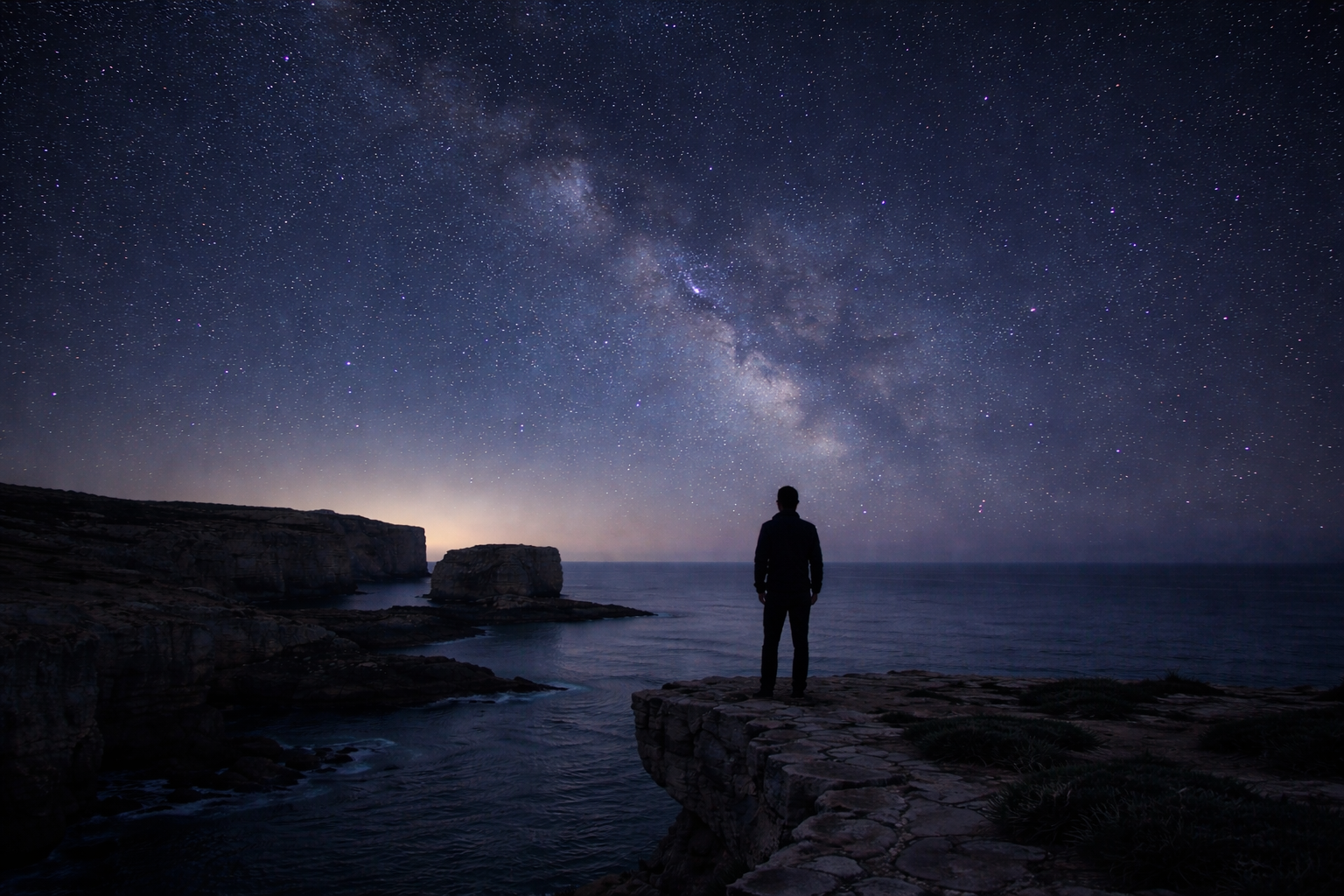
Stargazing in Gozo is best along the island’s west and north coasts, where low light pollution and open sea views create darker skies. On clear, moonless nights, the Milky Way is visible to the naked eye.
Where to Stargaze in Gozo
- Dwejra Bay – darkest skies and wide west-facing horizon
- Ta’ Ċenċ Cliffs – elevated viewpoints above open sea
- Wied il-Għasri – secluded valley with minimal side light
- Ramla Bay – accessible beach setting for relaxed stargazing
Step beyond the brightest village streets and let your eyes adjust. Gradually, the island reveals something unexpected — a deeper, darker sky where stars sharpen above limestone cliffs and the Mediterranean fades into shadow.
Compared to Malta’s main island, Gozo has noticeably lower light pollution and broader coastal horizons. In particular, the western and northern shores offer some of the best stargazing spots in Gozo. Here, open sea views and wide countryside allow the night sky to unfold naturally.
On clear, moonless evenings — especially between May and September — the Milky Way becomes visible to the naked eye.
During meteor showers such as the Perseids in August or the Geminids in December, the sky can feel cinematic. Streaks of light cross above the sea, bright and brief.
Gozo has no observatories or organised dark-sky parks. Instead, it offers something simpler: space, silence and natural darkness.
Why Gozo Is Good for Stargazing
The island’s smaller population and rural landscape mean fewer intense light sources. Once you move away from Victoria and the brighter harbour areas, large stretches of coastline remain comparatively dark.
The west coast is particularly rewarding. Facing open water, these cliffs and bays have very little artificial light. As a result, your eyes can adjust more easily.
Even without equipment, you can clearly see constellations and bright planets such as Jupiter or Venus. On the right night, you may even notice the faint structure of the Milky Way above Gozo.
Binoculars can enhance the experience. They reveal star clusters and more detail on the moon. However, they are not essential. The real strength of stargazing in Gozo is its accessibility. You need no heavy gear — only clear skies, the right conditions and a little patience.
Gozo vs Malta for Stargazing
While both islands offer coastal night views, Gozo provides darker skies and a more immersive stargazing experience.
| Factor | Gozo | Malta |
|---|---|---|
| Light pollution | Low, especially on west coast | High near urban areas |
| Milky Way visibility | Clearly visible on dark nights | Often faint or not visible |
| Best locations | Dwejra Bay, Xwejni, Nadur | Dingli Cliffs, Fomm ir-Riħ |
| Overall experience | Quiet, immersive, dark-sky feel | More limited, location-dependent |
Best Gozo Stargazing Spots
Dwejra Bay
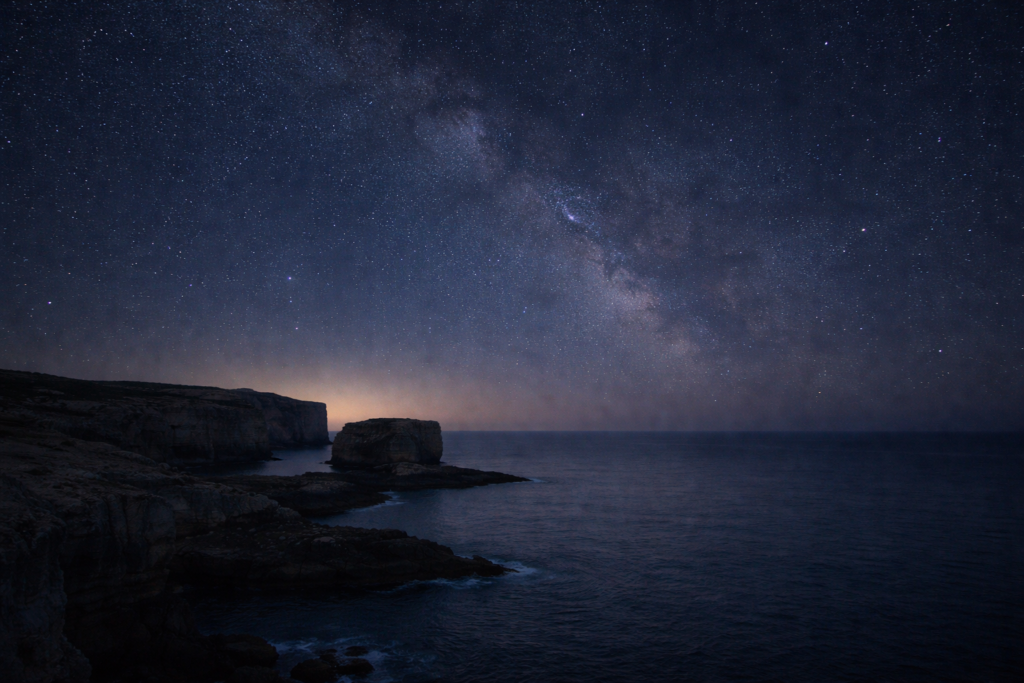
Often considered the island’s darkest accessible area, Dwejra Bay on the west coast offers expansive horizons and minimal direct light pollution. The coastline near the former Azure Window site is particularly good for Milky Way photography and peak meteor shower nights. With nothing but open sea ahead, the sky feels vast and uninterrupted.
Ramla Bay
Ramla Bay provides an easier, more comfortable setting. While not always the absolute darkest location, the wide sandy beach allows you to lie back and watch the stars with minimal effort. It’s an accessible choice for relaxed Gozo stargazing, especially in late spring and summer.
Ta’ Ċenċ Cliffs
High above the sea near Sannat, Ta’ Ċenċ offers elevated viewpoints and long sightlines. The openness makes it ideal for planet watching and moonrise moments over the Mediterranean. The quiet atmosphere adds to the sense of isolation under the stars in Gozo.
Wied il-Għasri
This narrow valley on the north coast feels secluded and calm after sunset in Gozo. The surrounding cliffs shield some side light, creating a more intimate setting for watching meteor showers in Malta’s darker corners. A headlamp is useful for the walk back.
Xagħra Countryside (near Ġgantija)
Although the Ġgantija Temples close after hours, the surrounding rural landscape remains softly lit and atmospheric. Fields and open terrain around Xagħra provide good views of constellations and are popular for night photography in Gozo.
Xlendi Bay and Nearby Cliffs
Xlendi itself can be brighter, but it works beautifully as a transition evening. Start with a sunset in Gozo by the water, then move slightly beyond the bay toward darker cliff viewpoints. The gradual shift from golden hour to a star-filled sky is part of the experience.
Best Time for Stargazing in Gozo (2026)
Timing matters more than equipment.
- Best months for the Milky Way in Gozo: May to September
- Peak meteor showers: Perseids (August), Geminids (December)
- Best time of night: roughly 10 pm to 2 am
- Avoid: full moon nights and hazy conditions
Even thin cloud layers reduce star contrast significantly. Choose a cloud-free forecast and, if possible, nights around the new moon for the darkest skies.
Meteor Showers 2026 Worth Planning Around
If you are timing your visit precisely, these 2026 peak nights are the most reliable:
- Lyrids: April 22–23, 2026
- Eta Aquariids: May 5–6, 2026
- Perseids: August 12–13, 2026 — traditionally one of the most consistent summer displays
- Orionids: October 21–22, 2026
- Geminids: December 13–14, 2026 — often the most intense meteor shower of the year
The Perseids in August are particularly rewarding in Gozo, especially along the darker west coast around Dwejra Bay.
Best Milky Way Nights in 2026 in Gozo
or Milky Way visibility in Gozo, focus on the 3–5 nights around each new moon. In 2026, the most promising windows fall around:
- May 16
- June 14
- July 14
- August 12 (coinciding with Perseids peak)
- September 10
On these darker evenings, the galactic core rises more clearly above Gozo’s southern horizon, particularly between late spring and early autumn.
Practical Tips for Starry Nights in Gozo
- Go moonless. The Milky Way is far more visible when the moon is new or below the horizon.
- Let your eyes adjust. Avoid checking your phone repeatedly; it takes about 20 minutes for full night adaptation.
- Bring binoculars. They make planets and star clusters noticeably sharper.
- Use a stargazing app. Tools like Stellarium help identify constellations and track meteor showers over Malta and Gozo
- Plan transport in advance. Late buses are limited, and some of the best stargazing spots in Gozo are easier to reach by car.
- Pack simply. A warm layer, water, a small headlamp, and something comfortable to sit on are usually enough.
Gozo and the Rise of Mediterranean Astrotourism
With open sea-level horizons, rural areas of low light and cliff viewpoints that are easy to reach, the island offers unusually accessible night-sky experiences.
While light pollution is increasing across much of Europe, Gozo’s western coastline still remains relatively dark. In particular, the area around Dwejra continues to provide some of the most rewarding dark-sky settings in the Maltese Islands.
The Vibe – The Atmosphere of a Gozo Night
Stargazing in Gozo is not structured or commercial. There are no scheduled Milky Way viewings, no ticket counters and no guided platforms.
Instead, you find the quiet edge of a cliff, the soft sound of waves below and the gradual emergence of stars above. As your eyes adjust, the sky begins to reveal more: depth replaces darkness, and patterns replace randomness.
On the right night, Gozo feels less like an island and more like an open-air planetarium — simple, calm and quietly unforgettable.
At the same time, Gozo astronomy tourism is slowly emerging as a niche travel trend. More visitors are seeking dark skies, low light pollution and immersive night-sky experiences along the island’s dramatic Mediterranean coastline.
For now, however, Gozo stargazing is not about observatories or organised tours.
Rather, it is about stepping away from artificial light, finding a quiet cliff or beach and watching the sky unfold at its own pace.
Stay at least one night. Gozo’s sky only reveals itself after the last ferry leaves.
FAQs -Stargazing in Gozo
When is the best time to go stargazing in Gozo?
The clearest skies usually appear between late spring and early autumn. For the darkest conditions, plan your visit around the new moon, when the sky is free from strong moonlight.
On cloudless nights between May and September, the Milky Way is often visible from Gozo’s quieter coastal areas.
What are the best places to stargaze in Gozo?
Dwejra Bay is widely considered the island’s strongest dark-sky location thanks to its open west-facing horizon.
Ta’ Ċenċ Cliffs offer elevated viewpoints, while Wied il-Għasri provides a more secluded setting. Ramla Bay is an easier, comfortable option for relaxed beach stargazing.
Can you see stars and the Milky Way in Gozo?
Yes — under the right conditions. On clear, moonless nights away from brighter village centres, the Milky Way can be visible to the naked eye. The galactic core is typically most noticeable from late spring through early autumn.
What are the most important meteor shower dates in 2026?
In 2026, notable peak nights include the Lyrids (April 22–23), Eta Aquariids (May 5–6), Perseids (August 12–13), Orionids (October 21–22), and Geminids (December 13–14). The Perseids and Geminids are usually the most reliable for higher meteor activity.
Do I need special equipment for stargazing in Gozo?
No telescope is required. Most visitors stargaze with the naked eye.
A simple pair of binoculars enhances detail and makes planets and star clusters more vivid, but the experience remains accessible without technical gear.
Is Gozo a good destination for astrotourism?
While not a designated dark-sky reserve, Gozo is increasingly appreciated as a Mediterranean astrotourism destination.
Its open sea horizons, rural landscapes, and relatively low light pollution — particularly along the west coast. This is why it makes it one of the more accessible night-sky experiences in southern Europe.
Is Gozo better than Malta for stargazing?
Yes. Gozo is better than Malta for stargazing because it has lower light pollution, darker skies, and more open coastal viewpoints. As a result, stars appear clearer and more numerous.
But can you still go stargazing in Malta?
Yes, but Malta stargazing conditions are more limited. The best areas in Malta include Dingli Cliffs, Fomm ir-Riħ, and Għajn Tuffieħa. Even there, visibility is usually lower than in Gozo.