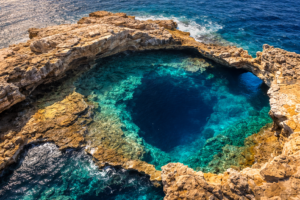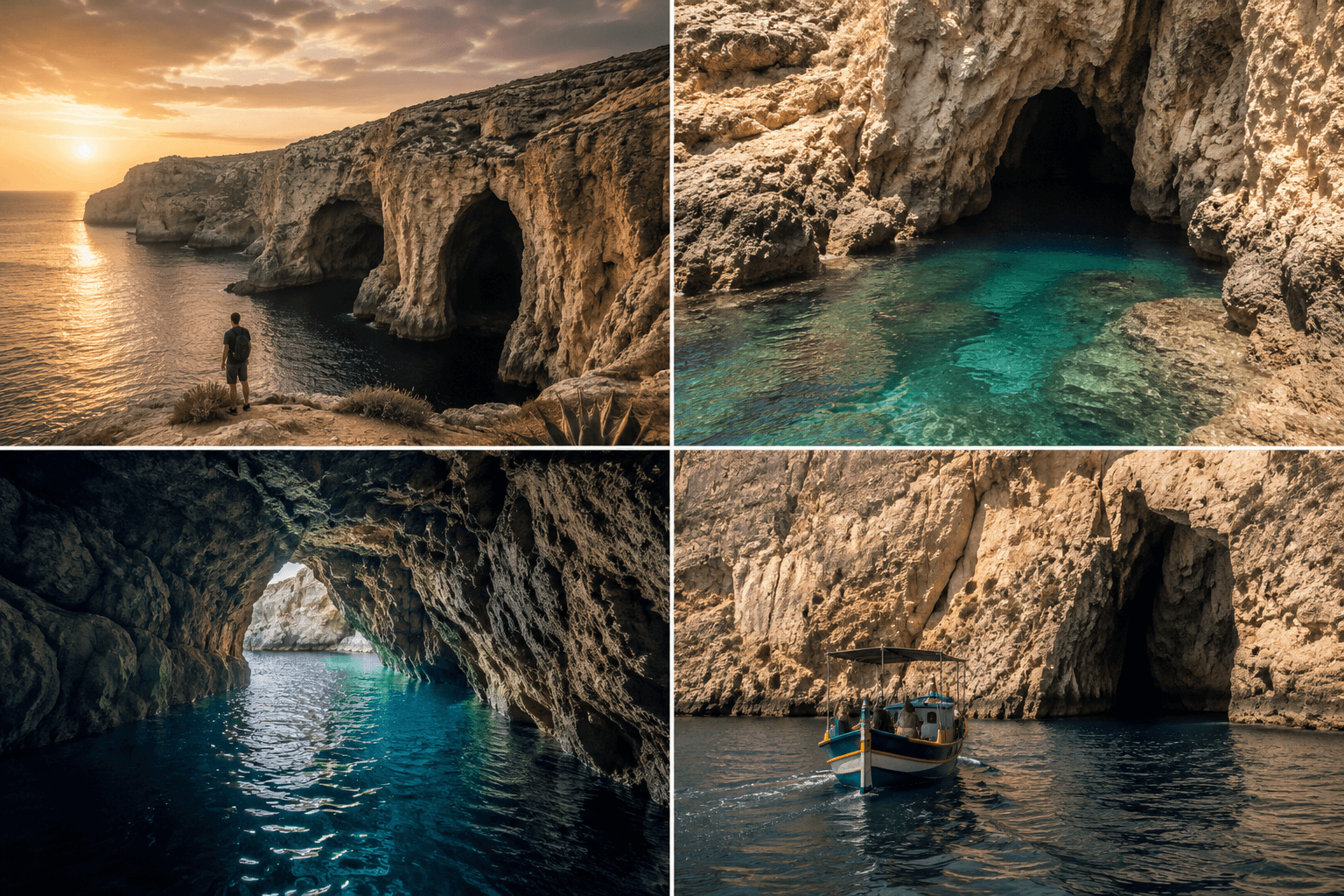
The best caves in Gozo range from Tal-Mixta Cave overlooking Ramla Bay to underground limestone grottos in Xagħra and spectacular sea caves explored by divers. Tal-Mixta is the obvious choice for views, while Xerri’s Grotto and Ninu’s Cave offer a completely different experience beneath the streets of Xagħra.
Along the coast, Gozo becomes wilder. The Inland Sea tunnel, Cathedral Cave at Wied il-Għasri and numerous underwater caverns have helped make the island one of the Mediterranean’s best-known diving destinations.
Not every cave can simply be walked into, however. Some are private attractions, some are reached only underwater, and access to others can change because of rock stability or sea conditions.
This guide explains which Gozo caves are actually worth visiting, how you can experience them and what to know before you go.
Best Caves in Gozo at a Glance
| Cave | Best for | Access | Location |
|---|---|---|---|
| Tal-Mixta Cave | Ramla Bay views | Walk | Nadur/Ramla |
| Xerri’s Grotto | Stalactites & stalagmites | Paid/private | Xagħra |
| Ninu’s Cave | Underground formations | Paid/private | Xagħra |
| Calypso’s Cave | Mythology & Ramla landscape | Access restricted | Xagħra |
| Inland Sea Tunnel | Boats & diving | Boat/dive | Dwejra |
| Cathedral Cave | Cave diving | Dive | Wied il-Għasri |
| Xlendi caves | Coastal exploration & diving | Varies | Xlendi |
| Mġarr ix-Xini caves | Diving | Dive | Mġarr ix-Xini |
| Santa Maria Caves | Boat trips & diving | Boat/dive | Comino |
1. Tal-Mixta Cave – The Best Cave View in Gozo
Tal-Mixta Cave is the most famous cave viewpoint in Gozo and one of the island’s classic natural sights.
The broad limestone opening sits high above Ramla Bay, framing the beach, surrounding hills and Mediterranean almost like a natural window.
It is the view rather than the cave interior that makes Tal-Mixta special.
Visit Gozo describes the cave as one of the island’s most photogenic locations and recommends approaching from the Nadur side via the country roads leading towards Ramla.
The final approach is on foot.
Once inside the opening, the contrast between the shaded limestone and bright red-orange sand below creates one of Gozo’s most recognisable views.
Is Tal-Mixta Cave Worth Visiting?
Yes, especially if this is your first visit to Gozo.
It combines three things particularly well:
- one of the best views over Ramla Bay
- an interesting natural limestone formation
- a short countryside walk
It is also easy to combine with a visit to the beach below.
Best Time to Visit Tal-Mixta Cave
Morning and late afternoon both work well.
The cave has become increasingly popular, so arriving earlier can make the experience considerably calmer.
In summer, avoiding the hottest part of the day also makes the walk more comfortable.
For access details, directions and photography tips, use our complete Tal-Mixta Cave guide.
2. Xerri’s Grotto – Underground Gozo
Xerri’s Grotto is one of the best caves in Gozo if you actually want to go underground.
It sits beneath a private property in Xagħra, far from the dramatic sea cliffs that define many of Gozo’s better-known caves.
The grotto was discovered in 1923–24 by Anthony Xerri while excavating a well.
Instead of finding water, he uncovered a natural cave approximately ten metres below ground.
Visit Gozo’s Xagħra Heritage Trail explains that a spiral staircase now descends through the original well shaft into the cave. Inside are numerous alabaster stalactites and stalagmites, generally ranging from around 25 centimetres to one metre in height.
Some formations developed around tree roots as calcium carbonate accumulated over time.
The cave was later used as an air-raid shelter during the Second World War.
Can You Visit Xerri’s Grotto?
Yes. Xerri’s Grotto is privately managed and entrance tickets are sold on site.
Because opening arrangements and prices can change, I would check locally before making a special journey rather than publishing a fixed timetable that may quickly become outdated.
The cave is accessed by a spiral staircase and is therefore quite different from an open coastal attraction.
How Long Do You Need?
This is a relatively small cave rather than an enormous underground system.
A visit fits easily into a wider exploration of Xagħra.
That makes it particularly easy to combine with Ninu’s Cave and the Ġgantija area.
3. Ninu’s Cave – Xagħra’s Other Underground Grotto
Only a short distance from Xerri’s lies Ninu’s Cave, another remarkable natural cavity hidden beneath Xagħra.
The two are often mentioned together, but they are separate caves.
Ninu’s Cave was discovered in the late nineteenth century and contains numerous stalactites, stalagmites and other calcite formations.
What makes the experience memorable is the setting.
You enter an ordinary village property and descend below street level into a natural limestone chamber that gives almost no indication of its existence from outside.
Visit Gozo highlights both Ninu’s Cave and Xerri’s Grotto among Xagħra’s unusual attractions and specifically notes their stalagmite and stalactite formations.
Xerri’s Grotto or Ninu’s Cave?
If you have enough time, visit both.
They are close together and provide slightly different underground formations.
If you only want to choose one, Xerri’s Grotto is generally the more substantial visit, while Ninu’s Cave is an interesting addition when exploring Xagħra.
Do not expect either to resemble a vast commercial show cave.
Their appeal is precisely that these natural formations sit beneath an otherwise ordinary Gozitan village.
4. Calypso’s Cave – Myth, Homer and Ramla Bay
Calypso’s Cave is Gozo’s most famous mythological cave.
Tradition associates the location with Calypso from Homer’s Odyssey, the nymph who kept Odysseus on the island of Ogygia for seven years.
There is no archaeological evidence proving that Gozo was Homer’s Ogygia.
The association is part of the island’s long-established mythology rather than a historical fact.
That distinction makes the story more interesting, not less.
The cave sits on the Xagħra side of Ramla Bay, opposite Tal-Mixta.
Can You Enter Calypso’s Cave?
Do not assume that the cave itself is open for entry.
Access has repeatedly been restricted because of geological stability, and recent official documentation has referred to structural consolidation and accessibility works at the site.
The surrounding area remains interesting for its connection with the Odyssey and views towards Ramla, but current access conditions should be checked before making a special trip.
If your priority is a cave you can actually walk into for a spectacular Ramla view, Tal-Mixta is the stronger choice.
Tal-Mixta Cave vs Calypso’s Cave
The two caves overlook opposite sides of Ramla Bay but provide very different experiences.
Choose Tal-Mixta Cave for:
- the classic Ramla Bay panorama
- photography
- a cave you can experience as part of a walk
- sunrise or late-afternoon scenery
Choose the Calypso area for:
- Homer and the Odyssey
- Gozo mythology
- views from the Xagħra side
- combining the stop with Xagħra
For most first-time visitors, Tal-Mixta is the more rewarding cave experience.
See our Ramla Bay guide if you want to explore the landscape below both caves.
5. Inland Sea Tunnel – Gozo’s Most Unusual Sea Passage
At Dwejra, the definition of a cave becomes more dramatic.
The Inland Sea is a sheltered coastal lagoon connected to the open Mediterranean by a natural tunnel through the cliffs.
Small local boats travel through the passage when sea conditions allow.
The experience begins on calm water beside fishermen’s huts before entering the dark limestone tunnel. At the other end, the passage suddenly opens onto the deep blue Mediterranean and Dwejra’s exposed western cliffs.
It is one of the easiest ways for non-divers to experience Gozo’s sea-cave geology from the water.
Can You Take a Boat Through the Inland Sea Tunnel?
Yes, when sea conditions permit.
Local boats operate from the small jetty inside the Inland Sea.
The classic trip lasts around 20 minutes and continues beyond the tunnel to give passengers views of Dwejra’s cliffs, caves and rock formations.
For everything you need to know about boats, swimming and diving here, see our Inland Sea Gozo guide.
Can You Dive the Inland Sea Tunnel?
Yes.
The tunnel is also a well-known Gozo dive site, but it is a very different proposition underwater than it appears from the lagoon.
Divers travel from the Inland Sea through the limestone passage and emerge along Dwejra’s deep outer coastline.
It should be treated as a proper dive rather than somewhere casual swimmers should attempt to explore independently.
6. Cathedral Cave – Gozo’s Spectacular Underwater Cavern
Cathedral Cave is one of Gozo’s most distinctive cave dives.
It lies near the entrance to Wied il-Għasri on the island’s north coast.
According to Visit Gozo’s official diving information, the underwater entrance is only around five metres below the surface.
The passage leads into a huge domed chamber where divers can surface inside a large air pocket.
The ceiling rises approximately 15 metres above the water.
A crack in the cliff allows fresh air and additional natural light into the chamber.
This combination creates the cathedral-like atmosphere that gives the cave its name.
Can Non-Divers Visit Cathedral Cave?
Not in the same way as Tal-Mixta or Xerri’s Grotto.
Cathedral Cave is primarily an underwater diving site.
You can, however, visit the beautiful valley and inlet from land.
Our Wied il-Għasri guide explains how to reach the narrow gorge and small pebbly bay.
7. Caves Around Wied il-Għasri
Cathedral Cave is not the only reason cave enthusiasts should know Wied il-Għasri.
The narrow limestone gorge itself leads directly to the sea, and the surrounding underwater coastline contains caves popular with divers.
Visit Gozo notes that the area attracts divers specifically because of these underwater formations.
There is also an unusual cave where the valley reaches the sea with a shaft extending towards the top of the cliffs. Historically, equipment was used here to raise seawater for nearby salt pans.
Even if you never enter a cave, the gorge provides an excellent introduction to the forces that have shaped Gozo’s limestone coast.
8. Xlendi Caves – Coastal Caves Close to the Village
Xlendi is better known for swimming and waterfront restaurants, but the surrounding limestone contains several caves and passages.
One of the easiest to encounter from land is Caroline’s Cave, reached via steps along the cliffside.
The cave has a curious local history and was once associated with a bathing place used by Dominican nuns.
Underwater, Xlendi also has established cave and reef diving.
This makes Xlendi particularly useful if you want to combine caves with an easy seaside village rather than planning a remote coastal expedition.
See our complete Xlendi Bay guide for swimming, walking, Caroline’s Cave and the surrounding cliffs.
9. Mġarr ix-Xini – A Gorge with Underwater Caves
Mġarr ix-Xini is one of Gozo’s most beautiful narrow inlets.
Steep limestone walls surround a sheltered bay, and several caves can be found underwater along the cliff faces.
Visit Gozo highlights these formations as one of the reasons the inlet attracts divers.
Mġarr ix-Xini is also known as a good night-diving area because of its sheltered setting and relatively shallow sections.
Non-divers still have plenty of reason to visit.
The inlet itself, historic watchtower and walking path make this one of Gozo’s strongest combinations of coast, geology and history.
10. Coral Cave and Gozo’s Deeper Diving Caves
For experienced divers, Gozo’s cave landscape extends much further below the surface.
One example is Coral Cave.
Visit Gozo describes a huge entrance beginning at approximately 17 metres and extending towards a seabed around 28 metres deep.
The cave is notable for its marine life and walls covered with colourful sponges, tunicates, corals and other organisms.
Other dive sites around Gozo include caverns, fissures, arches and swim-throughs.
This is a completely different category from visiting Tal-Mixta with a camera.
Anyone planning cave or cavern diving should use an appropriate local dive centre and choose sites that match their certification and experience.
Our Gozo diving guide covers the island’s wider underwater landscape.
11. Santa Maria Caves – The Comino Addition
Technically, Santa Maria Caves are on Comino rather than Gozo.
They still deserve a place in this guide because many travellers explore them during boat trips from Gozo.
The caves and rocky passages around Comino are known for clear water and dramatic underwater light.
They are popular with boat excursions, snorkellers and divers, depending on the particular location and sea conditions.
Visit Gozo includes Santa Maria Caves among its notable Gozo-and-Comino diving sites.
If you want to combine Gozo with Comino, see our Comino from Gozo guide.
Which Gozo Caves Can You Actually Enter?
This is where the different types of cave become important.
Caves You Can Visit on Foot
Tal-Mixta Cave is the obvious open-air cave experience, reached as part of a countryside walk.
Xerri’s Grotto and Ninu’s Cave are underground attractions accessed through private properties in Xagħra.
Caves Best Experienced by Boat
The Inland Sea tunnel at Dwejra can be explored on a short local boat trip when conditions allow.
Several caves around Comino are also approached on boat excursions.
Caves for Divers
Gozo’s underwater cave and cavern sites include:
- Cathedral Cave
- Inland Sea Tunnel
- Coral Cave
- caves around Mġarr ix-Xini
- other caverns, arches and swim-throughs around the coastline
Some require considerably more diving experience than others.
Caves with Restricted Access
Calypso’s Cave should be treated as access-restricted unless current local information confirms otherwise.
Rock stability, weather and conservation work can all change cave access.
Are Gozo’s Caves Free to Visit?
Some are.
Tal-Mixta Cave can be visited without an attraction entrance ticket.
Natural coastal viewpoints and landscapes are generally free as well.
Xerri’s Grotto and Ninu’s Cave are privately managed, so admission charges may apply.
Boat trips through the Inland Sea and organised diving obviously involve separate costs.
Rather than relying on old online price lists, check current admission and operating information for privately run caves before visiting.
Best Cave in Gozo for Different Visitors
If you only have time for one cave, choose according to what you actually want.
Best cave for views: Tal-Mixta Cave
Best underground cave: Xerri’s Grotto
Best cave for mythology: Calypso’s Cave area
Best cave experience by boat: Inland Sea Tunnel
Best cave for divers: Cathedral Cave
Best cave-and-beach combination: Tal-Mixta + Ramla Bay
Best caves near a village: Xerri’s + Ninu’s in Xagħra
Best cave area for non-divers and divers together: Dwejra
There is no single “best cave in Gozo” because these places have very little in common beyond limestone.
That variety is precisely what makes them interesting.
Best Gozo Caves Without Diving
You do not need scuba gear to experience Gozo’s cave landscape.
For a cave-focused day without diving, I would choose:
Morning: Xerri’s Grotto and Ninu’s Cave in Xagħra.
Late morning: Continue towards Ramla Bay.
Afternoon: Visit Tal-Mixta Cave from the Nadur side.
On another day, combine the Inland Sea boat trip with the Blue Hole and Dwejra.
That gives you underground formations, a panoramic cave and a natural sea tunnel without entering a technical diving environment.
Gozo Caves for Scuba Diving
Gozo’s limestone geology is one of the reasons the island has such a strong international diving reputation.
Caves, caverns, tunnels, vertical walls and arches appear at dive sites around the coastline.
Among the best-known cave-related dives are Cathedral Cave, Inland Sea & Tunnel and Coral Cave.
Conditions and difficulty vary considerably.
A site with an easily accessible entrance is not necessarily an easy dive.
Visit Gozo itself differentiates sites by experience level, and local operators can adjust dive plans according to weather, certification and diver experience.
For dive planning, start with our scuba diving in Gozo guide.
Best Time to Visit Caves in Gozo
The best season depends on the cave.
Spring
Spring is one of the best periods for Tal-Mixta and other caves reached through countryside walks.
Temperatures are comfortable and Gozo is greener than during summer.
Summer
Summer provides long days and generally warmer swimming conditions, but exposed walks can become extremely hot.
Visit outdoor caves early or later in the day.
Underground caves such as Xerri’s and Ninu’s offer a completely different environment away from the summer sun.
Autumn
Early autumn combines warm sea temperatures with increasingly comfortable walking conditions.
This can be an excellent period for mixing coastal exploration with swimming.
Winter
Gozo’s cliffs become much more dramatic in rough winter weather.
That does not mean you should approach sea caves during storms.
Strong waves can make coastal rocks, cave entrances and exposed cliff areas extremely dangerous.
See our best time to visit Gozo guide for a complete seasonal comparison.
Are Gozo Caves Safe?
Most tourist-accessible caves can be enjoyed safely if you treat them according to their environment.
An underground private grotto and an exposed sea cave require completely different precautions.
For Coastal Caves
- Check sea and wind conditions.
- Never enter a sea cave during rough weather.
- Stay away from unstable cliff edges.
- Remember that waves can reach much higher than expected.
- Wear footwear with grip.
For Inland Caves
- Use designated entrances.
- Follow instructions from the operator.
- Do not touch stalactites or stalagmites.
- Be prepared for steps and confined spaces.
For Diving Caves
- Use qualified local operators.
- Dive within your certification and experience.
- Never treat an underwater cave as a casual swim-through.
- Check conditions before every dive.
Gozo’s geology is part of what makes the island spectacular.
It also deserves respect.
Are There Hidden Caves in Gozo?
Yes, in the sense that Gozo’s coastline contains numerous small caverns, fissures and underwater openings.
But visitors should be wary of social-media promises of a “secret cave” that supposedly requires climbing over cliffs or swimming into unknown passages.
A place being difficult to reach does not automatically make it a good tourist attraction.
If you want to explore beyond Gozo’s headline sights without taking unnecessary risks, our hidden places in Gozo guide is a better starting point.
How Gozo’s Caves Were Formed
Gozo is largely composed of sedimentary limestone formed from marine deposits millions of years ago.
Water then continued the work.
Rainwater moved through cracks and slowly dissolved soluble rock, helping create underground cavities and the stalactites and stalagmites found beneath Xagħra.
At the coast, waves, salt and erosion exploited weaknesses in the limestone, gradually producing caves, arches, tunnels and narrow inlets.
That is why Tal-Mixta, Xerri’s Grotto and the Inland Sea look completely different while still belonging to the same broader geological story.
Gozo’s caves are not isolated curiosities.
They are part of the landscape itself.
A Simple Gozo Cave Itinerary
If caves are one of your priorities, split them geographically rather than driving back and forth across the island.
Xagħra and Ramla
Start with Xerri’s Grotto and Ninu’s Cave.
Continue towards Ramla Bay and finish with Tal-Mixta Cave.
This is the strongest route for non-divers.
Dwejra
Combine the Inland Sea, tunnel boat trip and Blue Hole.
Allow additional time for Dwejra’s cliffs, Fungus Rock and coastal landscape.
Wied il-Għasri
Visit the gorge from land and leave Cathedral Cave to properly equipped divers.
This can also form part of a longer north-coast exploration.
For a wider island plan, see our complete Gozo itinerary.
Are Gozo’s Caves Worth Visiting?
Yes, but choose the cave that matches the experience you want.
Tal-Mixta is about the view.
Xerri’s and Ninu’s are about what lies beneath Gozo’s villages.
Calypso’s Cave connects the landscape with one of the Mediterranean’s oldest stories.
At Dwejra, the Inland Sea tunnel demonstrates the power of coastal erosion.
And underwater, Cathedral Cave and Gozo’s other caverns reveal an entirely different island.
You do not need to see them all.
Two or three carefully chosen caves will tell you far more about Gozo than rushing from one pin on a map to another.
FAQ About Caves in Gozo
What are the best caves in Gozo?
The best-known caves in Gozo include Tal-Mixta Cave above Ramla Bay, Xerri’s Grotto and Ninu’s Cave in Xagħra, the Inland Sea tunnel at Dwejra and Cathedral Cave near Wied il-Għasri. The best choice depends on whether you want views, underground formations, a boat trip or diving.
Which cave in Gozo has the best view?
Tal-Mixta Cave has the most famous cave view in Gozo. Its broad limestone opening frames Ramla Bay and the surrounding countryside from above, making it particularly popular for photography and scenic walks.
Can you enter caves in Gozo?
Yes. Tal-Mixta can be visited on foot, while Xerri’s Grotto and Ninu’s Cave are privately managed underground attractions. Other caves, such as Cathedral Cave, are primarily dive sites. Access to Calypso’s Cave can be restricted and should be checked before visiting.
Are caves in Gozo free to visit?
Some are free. Tal-Mixta Cave and many natural coastal viewpoints do not require an entrance ticket. Private attractions such as Xerri’s Grotto and Ninu’s Cave may charge admission, while boat trips and organised cave dives have separate costs.
Is Calypso’s Cave open?
Access to Calypso’s Cave has been affected by geological stability issues and works around the site. Visitors should not assume the cave interior is accessible and should check current local information before making a special journey.
Can you visit sea caves in Gozo by boat?
Yes. The best-known example is the Inland Sea at Dwejra, where small boats travel through a natural tunnel to the open Mediterranean when sea conditions permit. Boat excursions from Gozo may also explore caves around nearby Comino.
What are the best caves in Gozo for diving?
Cathedral Cave, the Inland Sea tunnel and Coral Cave are among Gozo’s notable cave-related dive sites. Difficulty varies significantly, so divers should select sites appropriate to their certification and experience and use current local guidance.
Are Gozo’s caves safe to visit?
Tourist-accessible caves are generally safe when visitors follow local guidance and weather conditions are suitable. Coastal caves require particular caution during rough seas, while underwater caves should only be explored by appropriately trained and equipped divers.
Explore More of Gozo
Continue with our detailed Tal-Mixta Cave guide, explore the Inland Sea at Dwejra, discover more hidden places in Gozo or plan your trip with the best things to do in Gozo.