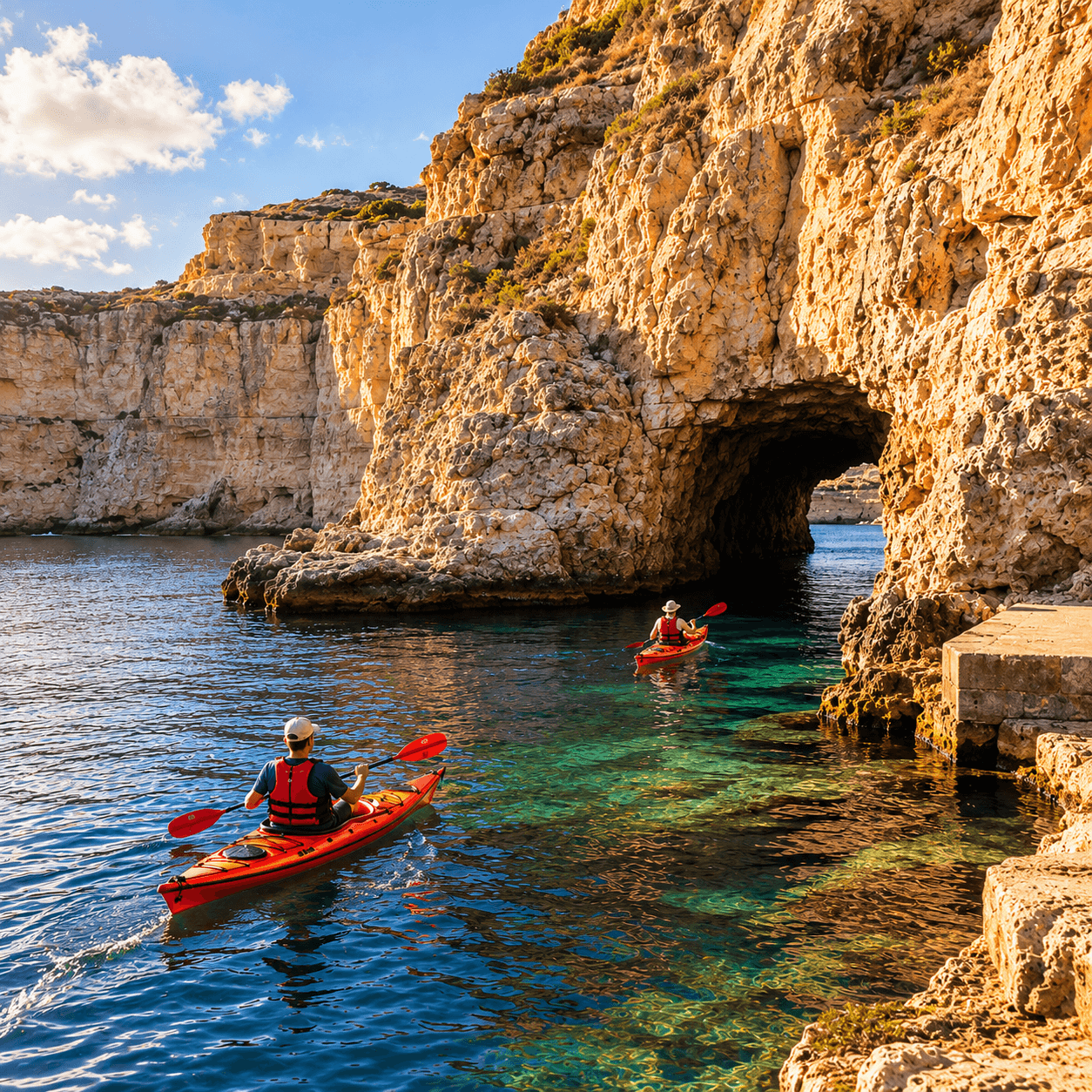
The Inland Sea at Dwejra is one of Gozo’s most unusual natural attractions: a sheltered coastal lagoon connected to the Mediterranean by a narrow tunnel through the limestone cliffs. Visitors come here to swim, take short boat trips through the tunnel, explore the dramatic Dwejra coastline or dive from the lagoon into deep open water.
The setting is compact, but there is much more here than a quick photo stop.
The Blue Hole, Fungus Rock, Dwejra Tower and the wider Dwejra landscape are all within walking distance, making the Inland Sea one of the easiest places in Gozo to turn into a half-day visit.
Inland Sea Gozo, Malta at a Glance
| Location | Dwejra, western Gozo |
| Type | Coastal lagoon |
| Known for | Natural sea tunnel and boat trips |
| Swimming | Yes, when conditions are suitable |
| Boat trips | Short trips through the tunnel |
| Diving | Advanced tunnel dive |
| Beach | Small pebbly shore |
| Nearby | Blue Hole, Fungus Rock, Dwejra Tower |
| Best time | Spring, early summer and autumn |
| Access | Road and nearby parking |
| From Victoria | Roughly 15 minutes by car |
| Time needed | 1–2 hours; longer for all of Dwejra |
What Is the Inland Sea in Gozo?
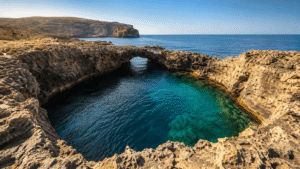
The Inland Sea is a natural lagoon at Dwejra on Gozo’s west coast, separated from the open Mediterranean by a high wall of limestone.
A natural tunnel through the cliffs connects the lagoon with the sea beyond.
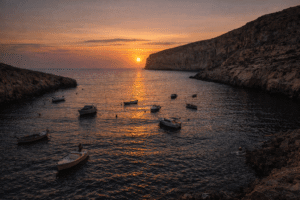
Visit Gozo describes the Inland Sea as a circular depression with a quayside on one side and a pebbly beach on the other. Small fishermen’s huts still stand beside the water, reflecting the lagoon’s traditional use as a sheltered fishing cove.
The result is an unusual landscape.
From the shore, the water appears almost enclosed. Only the dark opening in the rock reveals that the lagoon continues directly into the Mediterranean.
Why Is the Inland Sea Famous?
The main reason is the natural tunnel connecting the lagoon to the open sea.
Small boats pass through it, taking visitors from the sheltered Inland Sea into the dramatically different coastal landscape outside Dwejra.
According to official Visit Gozo information, the tunnel is roughly 80–100 metres long, depending on how its length is measured.
Inside, limestone walls rise closely around the water. At the far end, the tunnel suddenly opens onto deep blue Mediterranean sea and the cliffs of western Gozo.
That transition is what makes the Inland Sea much more interesting than an ordinary lagoon.
Inland Sea Boat Trips
A short boat trip through the Inland Sea tunnel is one of the best ways to experience Dwejra.
Small local boats depart from the jetty inside the lagoon and travel through the natural tunnel into the open Mediterranean.
Visit Gozo’s official Dwejra walking information describes the traditional boat excursion as lasting around 20 minutes, although routes and duration can vary depending on sea conditions.
Once outside the tunnel, boatmen can take visitors past sections of Dwejra’s cliffs, caves and rock formations that are difficult to appreciate properly from land.
The trip is short enough to add easily to a normal Dwejra visit.
How Long Is the Inland Sea Boat Trip?
Allow roughly 20 minutes for the classic trip, although the exact duration may vary.
You normally do not need to dedicate half a day to the boat ride itself.
The better approach is to combine it with the Blue Hole and the wider Dwejra coast.
Where Do the Boats Leave From?
Boats leave from the small jetty inside the Inland Sea lagoon.
The departure point is obvious once you reach the waterfront.
The vessels are small because they need to pass through the narrow natural tunnel.
Do Inland Sea Boat Trips Operate Every Day?
Not necessarily.
Boat trips depend heavily on weather and sea conditions.
The lagoon itself can look calm even when the open sea beyond the tunnel is too rough for boats to operate safely.
If taking the boat is a priority, allow some flexibility rather than planning your entire visit around a guaranteed departure.
Visit Gozo lists Dwejra boat trips among the island’s official boat-trip experiences.
Can You Swim in the Inland Sea?
Yes. Swimming is possible in the Inland Sea when conditions are suitable.
The inner lagoon is generally more sheltered than the exposed coastline outside Dwejra, and Visit Gozo specifically identifies it as a swimming location.
A small pebbly shoreline provides access to the water.
However, “sheltered” should not be confused with “always safe”.
Water conditions can still change, and boats use the lagoon and tunnel.
Swimmers should remain aware of boat traffic and avoid entering the tunnel itself as if it were an ordinary swimming passage.
For a more conventional beach day, compare the Inland Sea with the best beaches in Gozo.
Can You Swim Through the Inland Sea Tunnel?
Swimming through the tunnel is not something casual visitors should attempt.
The passage is used by boats and also forms part of an established dive site.
Once inside, conditions change considerably from those in the shallow lagoon.
The tunnel drops into substantially deeper water, and the open-sea conditions outside can be completely different from what you see from shore.
Enjoy the tunnel by boat unless you are diving it as part of a properly planned dive with appropriate experience and guidance.
Diving at the Inland Sea
The Inland Sea is also one of Dwejra’s major scuba-diving entry points.
Unlike the relatively relaxed surface experience inside the lagoon, the dive through the tunnel is not a beginner swim-through.
Visit Gozo currently classifies the Inland Sea dive as Advanced.
The official dive information gives an average depth of approximately 18 metres and a maximum depth exceeding 40 metres.
Divers enter from the Inland Sea and follow the tunnel towards the open Mediterranean. The seabed drops rapidly: the entrance is comparatively shallow before the passage descends significantly towards the outer coast.
The highlight comes when the dark tunnel frames the intense blue water outside.
Beyond the exit are vertical walls, fissures and caves along the Dwejra coastline.
If diving is one of the main reasons for your trip, see our complete Scuba Diving in Gozo guide.
Inland Sea or Blue Hole?
The Inland Sea and Blue Hole are two separate natural features, despite sitting only a short walk apart.
Choose the Inland Sea for:
- a sheltered lagoon
- short boat trips
- easy sightseeing
- swimming when conditions allow
- access to the Inland Sea dive
Choose the Blue Hole for:
- dramatic rock formations
- one of Gozo’s most famous dive sites
- deeper-water scenery
- views across the Dwejra coast
Most visitors do not need to choose.
The two sites are so close together that it makes much more sense to see both during the same visit.
Read our detailed Blue Hole Gozo guide before visiting.
Things to Do at the Inland Sea and Dwejra
The lagoon may be small, but the surrounding area contains several of Gozo’s best-known natural and historic attractions.
1. Take the Boat Through the Tunnel
This is the classic Inland Sea experience.
The lagoon only makes complete geographical sense once you pass through the rock and see how suddenly it opens onto the Mediterranean.
If boats are operating and sea conditions are good, it is worth doing.
2. Swim in the Lagoon
On warm, calm days, the Inland Sea provides a different swimming experience from Gozo’s exposed beaches.
There is no large sandy shore.
Instead, expect a compact lagoon and pebbly access with fishermen’s huts and boats around the water.
3. Walk to the Blue Hole
The Blue Hole is only a short walk away.
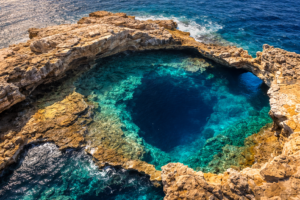
It is one of Gozo’s signature natural formations and particularly famous among scuba divers.
Even if you do not dive, the surrounding Dwejra rock formations are worth exploring from land.
4. See Fungus Rock
Across Dwejra Bay stands Fungus Rock, also known as the General’s Rock.
The isolated rock has a curious history.
During the period of the Knights of St John, a plant growing on the rock was highly prized for supposed medicinal properties. Access was consequently restricted and guarded.
Today, Fungus Rock remains one of the most recognisable landmarks along Gozo’s western coast.
5. Walk to Dwejra Tower
Dwejra Tower dates from 1652 and was constructed during the rule of Grand Master Lascaris.
Its position was strategic.
The tower helped protect this exposed section of coastline and guarded the area around Fungus Rock.
Visit Gozo notes that the tower also served a defensive role during the Second World War.
When open, a flag is normally visible from its rooftop.
6. Explore the Dwejra Coast
Do not restrict your visit to the lagoon.
The landscape surrounding Dwejra is one of Gozo’s most dramatic combinations of limestone, open sea and geological formations.
Visit Gozo’s official information specifically warns visitors to take care near the coastline during rough weather and to avoid exposed shore edges.
For more outdoor ideas, see our hiking in Gozo guide.
What Happened to the Azure Window?
Dwejra was once internationally famous for the Azure Window, a huge natural limestone arch standing beside the coast.
The arch collapsed into the sea during a storm on 8 March 2017.
Nothing comparable has been rebuilt or replaced.
The underwater remains are now part of Dwejra’s diving landscape.
The collapse changed the appearance of Dwejra but did not remove the reasons to visit.
The Inland Sea, Blue Hole, Fungus Rock and surrounding cliffs remain, and the area continues to be one of Gozo’s most distinctive natural landscapes.
Dwejra Without the Azure Window: Is It Still Worth Visiting?
Absolutely.
Treating Dwejra purely as the former home of the Azure Window undersells the area.
You still have:
- the Inland Sea
- the natural tunnel
- boat trips
- the Blue Hole
- Fungus Rock
- Dwejra Tower
- swimming
- scuba diving
- cliff scenery
- coastal walking
For a first-time visitor to Gozo, Dwejra remains one of the island’s strongest natural attractions.
How Long Do You Need at the Inland Sea?
Allow around one to two hours if your main focus is the Inland Sea itself.
That gives you time to look around the lagoon, take a boat trip if available and walk towards the nearby Blue Hole.
For the wider Dwejra area, two to three hours is more comfortable.
You can easily spend longer if you are walking, swimming or waiting for sunset.
If your Gozo schedule is limited, Dwejra fits naturally into a wider Gozo itinerary.
Best Time to Visit the Inland Sea
There is no single month when the Inland Sea works for everyone.
The best time depends on whether you are coming to swim, walk, take a boat or photograph Dwejra.
Spring
Spring is excellent for exploring the wider coastline.
Temperatures are more comfortable for walking and the surrounding countryside is greener than in summer.
Boat operations still depend on sea conditions.
Summer
Summer offers the warmest swimming conditions and the busiest atmosphere.
Arrive earlier in the day if you want to see the lagoon before most day visitors arrive.
Shade is limited around Dwejra, so the middle of the day can feel extremely hot.
Autumn
Early autumn is one of the strongest periods for combining swimming with sightseeing.
Sea temperatures remain warm while the summer crowds begin to ease.
Winter
Winter reveals Dwejra at its most dramatic.
Large waves and strong winds can completely transform the exposed coast.
The Inland Sea itself may still appear relatively protected, but boat trips can be cancelled when conditions outside the tunnel are unsuitable.
See our guide to the best time to visit Gozo for a broader seasonal comparison.
Best Time of Day for the Inland Sea
Morning is usually best if you want a quieter visit.
The Inland Sea is part of one of Gozo’s major sightseeing areas, so visitor numbers generally increase as day trips arrive.
Late afternoon can be beautiful for Dwejra’s scenery, particularly if you plan to stay for sunset.
If taking the boat trip is your main goal, however, do not leave it too late.
Operations depend on daylight, demand and sea conditions rather than a guaranteed fixed timetable.
Sunset at Dwejra
Dwejra is one of the strongest sunset areas on Gozo because of its exposed western position.
The Inland Sea itself is more enclosed, so the most dramatic views are usually found by walking out towards the open coast.
If you stay until sunset, combine the lagoon with the viewpoints around Dwejra rather than remaining at the water’s edge throughout the evening.
Read our guide to Dwejra Bay at sunset for more detail.
How to Get to the Inland Sea
The Inland Sea is located at Dwejra near San Lawrenz, on Gozo’s western side.
It is accessible by road and is much easier to reach than many of Gozo’s more remote coastal locations.
By Car
Driving is the simplest option if you are exploring several places around Gozo.
From Victoria, the journey is roughly 15 minutes depending on traffic.
Parking is available in the Dwejra area, although the busiest summer periods can be more crowded.
See our Gozo car rental guide if you are deciding whether you need a car.
By Bus
Dwejra can also be reached by public transport from Victoria.
Because bus routes and timetables can change, check current Malta Public Transport information before travelling rather than relying on an old timetable.
By Taxi or Transfer
Taxis and app-based/private transfer services are another straightforward option, particularly if you are travelling as a group.
Ask about the return journey if you plan to stay into the evening.
Can You Visit the Inland Sea Without a Car?
Yes.
The Inland Sea is one of Gozo’s natural attractions that can reasonably be visited without renting a car.
Public buses connect the Dwejra area with Victoria, and taxis are widely available around the island.
A car becomes more useful if you want to combine Dwejra with several remote attractions on the same day.
Is the Inland Sea Good for Families?
Yes, provided children are supervised around the water.
The compact layout means families do not need to undertake a long hike simply to see the lagoon.
The boat trip can also be an easy way to experience part of Gozo’s coastline without committing to a full-day cruise.
Remember that this remains a natural coastal environment.
There are boats in the lagoon, uneven limestone surfaces around Dwejra and deep water nearby.
For beach-focused days with children, also see our guide to the best family beaches in Gozo.
Inland Sea vs Xlendi
Both locations have sheltered water surrounded by limestone, but the experiences are very different.
Choose the Inland Sea if you want:
- unusual geology
- the tunnel boat trip
- the Blue Hole
- dramatic natural scenery
- diving
- a sightseeing stop
Choose Xlendi if you want:
- restaurants directly beside the water
- an easy seaside village
- longer swimming sessions
- evening atmosphere
- snorkelling
- waterfront dining
For most visitors, the answer is again: see both.
Xlendi Bay works better as a relaxed lunch, swim or evening destination, while the Inland Sea is part of a broader natural sightseeing experience at Dwejra.
What to Combine With the Inland Sea
Blue Hole
This is the obvious combination.
The two attractions are only minutes apart on foot.
Fungus Rock and Dwejra Tower
Both add context to the landscape and help turn a short Inland Sea stop into a more complete Dwejra visit.
San Lawrenz
The nearby village of San Lawrenz offers a complete contrast to the exposed coast.
Visit Gozo describes it as a small traditional village surrounded by the hills of western Gozo.
Ta’ Dbieġi Crafts Village
If you are interested in local crafts, the nearby Ta’ Dbieġi area can be incorporated into the same route.
Victoria
Dwejra also combines naturally with Victoria and the Citadel, particularly if you only have one day on Gozo.
A Simple Dwejra Itinerary
If you have around three hours, a practical route is:
1. Start at the Inland Sea
Walk around the lagoon and take the short boat trip if conditions allow.
2. Walk towards the Blue Hole
See the rock formations and open coast.
3. Continue towards Dwejra Tower and Fungus Rock viewpoints
Take your time rather than simply collecting photographs.
4. Stay for late afternoon light
If your schedule allows, Dwejra becomes particularly atmospheric as the sun lowers over the western coast.
This route gives you much more context than visiting the Inland Sea alone.
Practical Tips for Visiting the Inland Sea
- Wear footwear suitable for uneven limestone.
- Bring sun protection; shade is limited.
- Carry water, particularly in summer.
- Boat trips depend on sea conditions.
- Ask locally about the current boat price before boarding.
- Do not swim inside the tunnel used by boats.
- Keep children supervised around deeper water.
- Stay well back from exposed coastal edges during strong winds.
- Avoid slippery shoreline rocks during rough weather.
- Visit earlier for a quieter atmosphere.
- Combine the Inland Sea with the Blue Hole rather than treating them as separate trips.
- Allow additional time if you want to stay for sunset.
Is the Inland Sea Gozo Worth Visiting?
Yes. The Inland Sea deserves a place on a first Gozo itinerary, especially when combined with the wider Dwejra landscape.
The lagoon alone is interesting.
What makes it exceptional is the combination.
You can stand beside calm water and fishermen’s huts, travel by boat through a natural tunnel, emerge beneath towering Mediterranean cliffs and then walk a few minutes to the Blue Hole and Fungus Rock.
There are more beautiful swimming beaches in Gozo.
There are quieter bays.
There are places where you could spend longer doing nothing.
But very few places on the island pack as much geology, history, diving and coastal scenery into such a small area.
That is why the Inland Sea remains one of Gozo’s essential natural sights.
FAQ About the Inland Sea Gozo
What is the Inland Sea in Gozo?
The Inland Sea is a coastal lagoon at Dwejra on Gozo’s western coast. It is surrounded by limestone and connected to the open Mediterranean by a natural tunnel through the cliffs. The lagoon is used for swimming, boat trips and as an entry point for scuba diving.
Can you swim in the Inland Sea Gozo?
Yes. Swimming is possible in the sheltered lagoon when conditions are suitable. There is a small pebbly shore providing access to the water. Swimmers should remain aware of boats using the lagoon and should not attempt to swim through the boat tunnel.
Can you take a boat through the Inland Sea tunnel?
Yes. Small local boats operate from the jetty inside the lagoon and pass through the natural tunnel to the open sea when conditions allow. The classic trip lasts roughly 20 minutes and provides views of Dwejra’s cliffs and coastal formations.
How long is the Inland Sea tunnel in Gozo?
Official Visit Gozo material describes the natural tunnel as approximately 80 to 100 metres long. It connects the sheltered Inland Sea lagoon directly with the open Mediterranean and is used by both small boats and experienced scuba divers.
Is the Inland Sea worth visiting?
Yes. The Inland Sea is one of Gozo’s most distinctive natural attractions and is easy to combine with the Blue Hole, Fungus Rock and Dwejra Tower. Boat trips through the tunnel add a perspective on the coast that cannot be experienced from land.
Is the Inland Sea good for diving?
Yes, but the Inland Sea tunnel is an advanced dive rather than a beginner site. Visit Gozo lists an average depth of around 18 metres and depths exceeding 40 metres outside the tunnel. Divers should use appropriate experience and local guidance.
How long do you need at the Inland Sea?
Around one to two hours is enough for the lagoon, a boat trip and a short walk towards the Blue Hole. Allow two to three hours or longer if you want to explore the wider Dwejra coastline, Fungus Rock and Dwejra Tower.
How far is the Inland Sea from Victoria Gozo?
The Inland Sea is at Dwejra on Gozo’s western coast, roughly a 15-minute drive from Victoria under normal conditions. It can also be reached by public transport or taxi.
Explore More of Gozo
Continue with our Blue Hole Gozo guide, discover the best things to do in Gozo, explore hidden places in Gozo or plan the full trip with our Gozo itinerary.